Increasing the Quality, Services and Infrastructure in Lithuanian Courts
In 2020-2024 period, the Lithuanian Courts will implement the Justice and Home Affairs Programme, which will be carried out at the national level within the framework of Increasing the Quality, Services and Infrastructure in Lithuanian Courts Project.
Increasing the Quality, Services and Infrastructure in Lithuanian Courts Project is financed by the European Economic Area Financial Mechanism during the 2014-2021 period.
The project focuses on five strategic directions:
- Strengthening the transparency and independence of the judiciary.
- Improving the quality of court proceedings.
- Improving the quality of services provided by Lithuanian courts.
- Improving the judicial infrastructure.
- Increasing the security in Lithuanian courts.
During the Project, nine activities will be implemented at the national level in cooperation with Norwegian experts.
FAIR COURTS
1. Improving judge selection and evaluation mechanisms
Why is this important?
The activity aims is to develop a model of competencies for the selection and evaluation of judges, paying special attention to the evaluation of social and personal competencies of candidates for judges and judges while evaluating currently used competency evaluation methodologies for the process of applying for judges or periodic evaluation of judges. During the implementation of the activity, a model of competencies will be prepared as well as the procedure for the assessment of personal competencies, which should be approved by the Council of Judges. Strengthening the transparency of the judiciary selection mechanism and the independence of the members of the selection board are priority objectives in order to create an anti-corruption environment in the courts and to strengthen public confidence in the judiciary. This is also emphasised by the Council of Europe’s Group of States against Corruption (GRECO).
What will be done?
- Development of a model for the selection and evaluation of judges.
- Preparing the procedure for assessing personal competencies.
What is the purpose?
- Ensuring transparency of the mechanism.
- Strengthening the independence of the selection board members.
- Stronger anti-corruption environment.
- Greater public confidence.
2. An electronic tool for the selection and evaluation of judges and candidates for judges
Why is this important?
The tool is needed to collect, process, systematise and archive the data of judges and candidates for judges. At present, the data of persons wishing to take the examination of judges, candidates for judges and judges, the information and documents provided by them, which are important both in the selection process and later and in the process of judges’ evaluation, are stored in different databases. This complicates the data processing, data protection, insufficient traceability of information and its preservation, and complicates the continuity of its use. The absence of an automated document submission / reception system and the use of inefficient data processing tools leads to a prolonged judges’ selection procedure.
What will be done?
- An electronic tool for the selection and evaluation of judges and candidates for judges will be developed.
What is the purpose?
- More efficient data processing is ensured.
- Information traceability and storage is ensured.
- Greater data security.
- Shortened judges’ selection procedure.
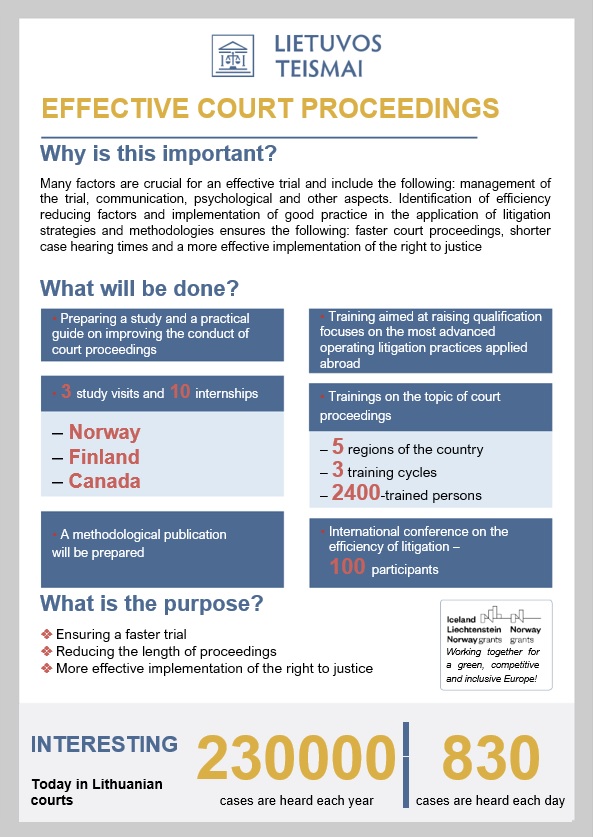
3. Improving the quality of court proceedings
Why is this important?
This activity aims to improve litigation quality by conducting monitoring in at least 200 different types of cases and their hearings in courts of varying instance, analyse foreign good practice, prepare a study and recommendations on improving the quality of litigation and draft legislation. The length of court proceedings correlates with the efficiency of court proceedings. At present, procedural laws set requirements for the conduct of court proceedings, but there is a lack of systematic research covering the management of court proceedings, communication and psychological aspects that affect the effective handling of a case. It is therefore necessary to analyse the litigation practice, to identify the problems most commonly encountered by courts and persons subject to the proceedings (litigants, prosecutors, lawyers, experts, specialists, witnesses, etc.), to identify the reasons that reduce the efficiency of court proceedings in various types (categories) of cases, to provide recommendations on their elimination and improvement of the efficiency of court proceedings. The long-term goal is to develop and implement universally applicable standards for the efficient conduct of court proceedings, thus ensuring faster / shorter court proceedings and more effective implementation of the right to justice.
What will be done?
- Preparing a study and a practical guide on improving the conduct of court proceedings.
- Three study visits will be organised (Norway, Finland and Canada). These visits will provide information on best practices in the conduct of court proceedings, which in turn will help to ensure procedural co-operation, efficient organisation of the proceedings, high standards of procedural culture and procedural fairness. The named countries were selected based on their advanced experience in the subject area of the study visits. Canada was chosen because of its global approach, high level of trust in the judiciary, its search for systemic opportunities, recent effective justice reforms as well as historical reasons. The Civil Code of the Canadian Province of Quebec was one of the main sources used in drafting the Civil Code of the Republic of Lithuania in 2000. During the study visits, analysis will be performed on the following topics: preparation for the proceedings, organisation of the proceedings, functions of the judge and their team, cooperation with persons subject to the proceedings, reasoning behind and explanation of court decisions to persons subject to the proceedings and the public as well as status / relations / role / cooperation of judges and experts. During the study visits, the participants will improve their qualifications while the information gathered and the experience gained will contribute to the improvement of the conduct of court proceedings.
- Ten internships are to be organised in order to raise qualifications and apply good practices of foreign countries.
- A methodological publication will be prepared. It will act as a practical guide for judges, prosecutors and lawyers on improving the quality of court proceedings. The publication will set out the essential principles and requirements to be followed by judges, prosecutors and lawyers in order to provide information on effective ways and means of conducting proceedings (including management, communication and psychological aspects) and to provide theoretical knowledge and practical advice on how to ensure a concentrated court process and a more effective implementation of the right to justice by considering different types (categories) of cases in courts of different instances. The publication will provide recommendations for court proceedings at different stages of court proceedings (preparing the case for court proceedings / organising preparatory court hearings, hearing the case on the merits in court, breaks between court hearings, etc.) and methodological advice in determining the functions of the judge and their team in court proceedings, in cooperation with the parties to the proceedings, experts, etc.
- Trainings on the topic of court proceedings will cover the following and include 5 regions of the country, 3 training cycles and 2400 persons to be trained. Trainings will cover these topics: preparation for the court hearing, organisation of preparatory hearings, determining the functions of the judge and their team, effective cooperation with the parties to the proceedings, experts, management of conflict situations, etc.
- Organisation of an international conference on the efficiency of litigation (100 participants) aiming to share good foreign practice on the application of litigation strategies and methodologies and effective cooperation in the judicial system. The international conference, which will be organised in Lithuania, will be attended by representatives of the project applicant, project partner and invited representatives of other foreign countries, who can share best practices in litigation and ensure cooperation between interested institutions.
What is the purpose?
- Developing and implementing standards for effective litigation.
- Implementing the most advanced operating litigation practices applied abroad.
- Ensuring a faster trial.
- Reducing the length of proceedings.
- More effective implementation of the right to justice.
INTERESTING
2019:
- Lithuanian courts have received more than 214 000 cases and examined 216 000 cases of different categories.
- The majority of cases examined in courts were civil disputes; last year over 132 000 were received in this category. The most typical civil cases were related to the repayment of loans, purchase and sale obligations as well as legal family relations including divorce and child support. In 2019, an increased number of cases on bankruptcy of natural persons was heard.
- The number of examined criminal cases amounted to more than 18 000. Lithuanian courts have mostly heard cases on causing health problems to a close relative or a family member, driving under the influence of alcohol, theft and other crimes against property. There has been a tendency for a decreasing number of cases in the mentioned categories over the past years.
- More than 37 000 administrative offence and administrative cases were examined in Lithuanian courts. There has been a significant increase in cases of administrative offences involving driving while intoxicated or under the influence of drugs, psychotropic or other psychoactive substances without the right to drive.
- Compared to 2017 (before the judicial reform), in 2019, the average duration of proceedings in district courts has shortened. In district courts, civil cases (examined in accordance with the general rules of litigation) were heard within an average of 95 days (91 in 2017), and criminal cases (examined in accordance with the general rules of procedure) within 119 days (126 in 2017). In regional administrative courts cases were heard within 100 days (118 days in 2017).
OPEN COURT
4. Increasing the openness and transparency of the judiciary in the eyes of the public
Why is this important?
Based on the 2020 data, 27.3 percent of population do not trust the judicial system in Lithuania. Population survey data shows that the society sees too little justice, which it is determined by the lack of knowledge among the public in the legal education field, insignificant public education efforts on behalf of the responsible institutions and confusion in relation to court proceedings. Courts are still considered a closed institution in the eyes of the public and inaccessible to the majority of the public. It is therefore necessary to increase the number of initiatives aimed at educating the public and raising awareness of fast and efficient court proceedings as well as inform the public on the progress, efficiency and effectiveness of the courts.
What will be done?
- Implementation of legal education campaigns for the Lithuanian public.
What is the purpose?
- The public gains a better understanding and appreciation of the work of the courts.
- Improving the reputation of the courts.
- Growing public confidence in the courts.
- Recognition of the courts as an open and transparent institution by the public.
INTERESTING
Every year the courts pay special attention to the legal education of the public.
- Participation in the “Kulturos naktis” (eng. Culture Night) Project.
- Participation in the “Butent” (eng. Exactly) Project.
- Initiation of the “Teisejas bibliotekoje” (eng. Judge in the Library) Legal Education Project.
- Organisation of Free Legal Advice Day “Jus klausiate – mes atsakome!” (eng. You Ask – We Answer).
- Organisation of the “Diena su teiseju” (eng. Day with a Judge) Project.
- Historical exposition on courts in the National Courts Administration is visited annually by about 1 200 visitors, of which 1 000 are students.
- More than 150 social initiative events and open days have been organised in the national courts and the NCA.
PROVIDING QUALITY SERVICES IN COURTS
5. Strengthening the managerial competencies of judges and court staff
Why is this important?
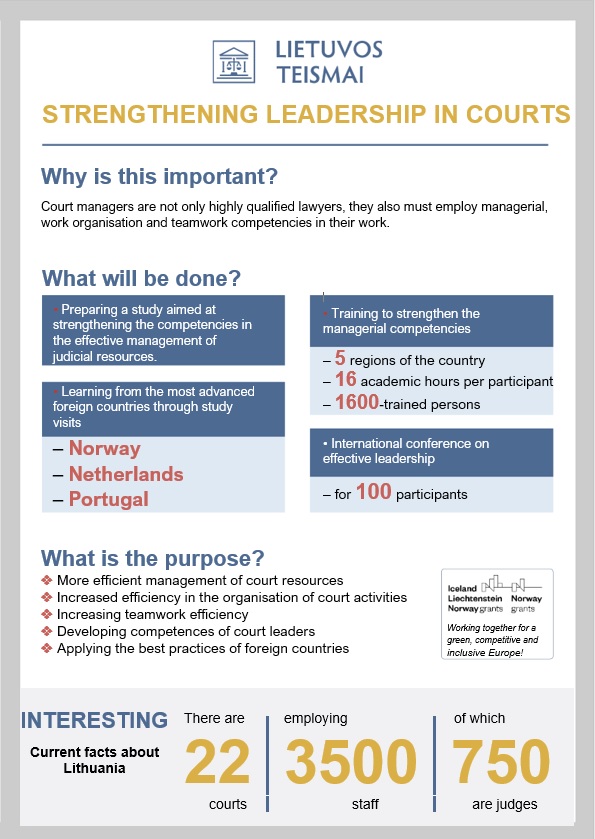
Court managers are not only highly qualified lawyers; they also must employ managerial, work organisation and teamwork competencies in their work. Effective application of these competencies allows ensuring effective management of human and other resources, improving court management processes and organisation of court activities, increasing employee job satisfaction and strengthening internal communication of the organisation.
What will be done?
- Preparing a study aimed at strengthening the competencies in the effective management of judicial resources. It will consist of a model of competencies for the top and middle managers of the court, selection and evaluation criteria, methodology and a mechanism for the corruption prevention control. This will allow for more efficient management of court resources, improvement of court management processes, organisation of court activities, selection of persons with the highest qualification and appropriate abilities as court leaders. Also, the development of this model would enable the existing court managers to improve their qualifications and acquire the necessary managerial knowledge and skills.
- Organising study visits to foreign courts (Norway, the Netherlands and Portugal). The study visits will include the following activities: court visits, getting to know the principles of designing court premises, the principles of adapting public premises to the needs of court clients and the strategies and methodologies of the court system management. During the study visits, the participants will improve their qualifications, the information gathered and the experience gained will contribute to the improvement of court management processes as well as creation and installation of refurbishable public spaces.
- Organising trainings to strengthen the managerial competencies covering five regions of the country and 1600-trained persons (16 academic hours per participant). Preliminary training topics include: 1) leadership, team building and coaching; 2) corruption prevention; 3) public speaking and effective communication, 4) conflict management; 5) emotional intelligence; 6) strategic planning; 7) staff culture formation.
- Organising an international conference on effective leadership for a 100 participants. The aim of the training is to organise an international conference to share best foreign practices on the role of leadership in ensuring quality services in the courts. The international conference, which will be organised in Lithuania, will be attended by representatives of the project applicant, project partner and invited representatives of other foreign countries, who can share best practices in litigation and ensure cooperation between interested institutions.
What is the purpose?
- More efficient management of court resources.
- Increased efficiency in the organisation of court activities.
- Increasing teamwork efficiency.
- Developing competences of court leaders.
- Applying the best practices of foreign countries.
SOCIALLY RESPONSIBLE COURTS
6. Social responsibility: improving the effectiveness of assistance provided to court visitors
Why is this important?
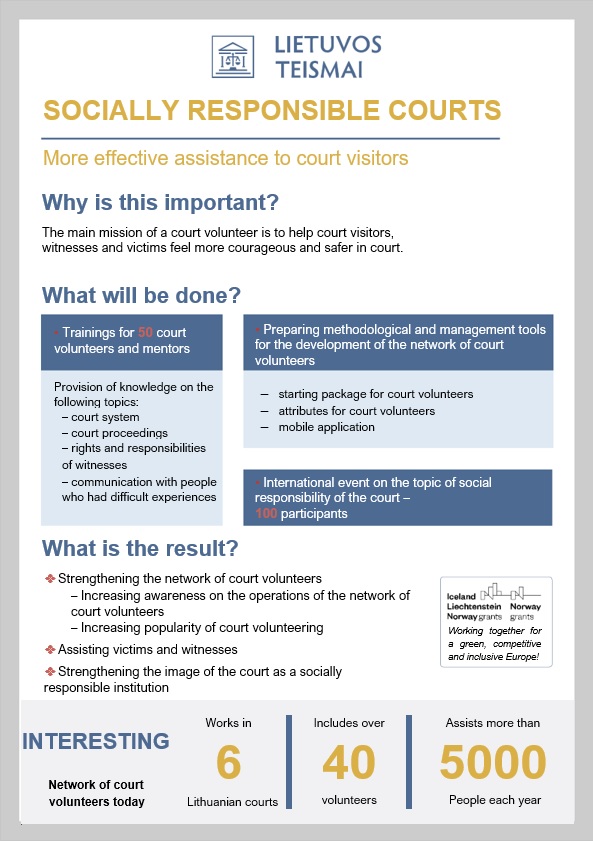
The main mission of a court volunteer is to help court visitors, witnesses and victims feel more courageous and safer in court. To do this, volunteers must have the necessary knowledge of the judicial system and the trial, the rights and responsibilities of witnesses and victims, know how to communicate with people who have experienced difficult experiences, and provide the necessary assistance to court visitors. The effectiveness of court volunteers depends not only on the volunteers’ knowledge, but also on the quality communication between the members of the organisation, continuous development of the volunteer team and the provision of the necessary work tools to the volunteers.
In 2009-2014, a volunteer network was established throughout the courts using the funds of the Norwegian Financial Mechanism Program’s Efficiency, Quality and Transparency in Lithuanian Courts Project named Better Assistance to Witnesses and Victims of Crime in Court proceedings Including Strengthening of Security in Court Buildings. The volunteering network covering courts has expanded from five pilot courts at the beginning of the project, and currently operates in six courts; the volunteer network continuously welcomes new members.
What will be done?
- Organising trainings for court volunteers and mentors (50 people). The aims of the training programs are as follows: 1) to provide as much theoretical and practical knowledge as possible to court volunteer mentors about working with court volunteers; 2) to provide the best possible theoretical and practical knowledge to court volunteers about working with witnesses and victims in courts.
- Preparing methodological and management tools for the development of the network of court volunteers, which include the starting package for court volunteers, attributes and mobile application.
- Organising an international event on the topic of social responsibility of the court (100 participants). The aim is to organise a public international event on the social responsibility of the court in order to popularise the activities of the network of court volunteers in Lithuania. The event, which will be organised in Lithuania, will be attended by experts who can share their experience on the importance of social responsibility of the courts and the services provided by the network of court volunteers.
What is the purpose?
- Strengthening the network of court volunteers.
- Assisting victims and witnesses.
- Increasing awareness on the operations of the network of court volunteers.
- Increasing popularity of court volunteering among the potential court volunteers.
- Strengthening the image of the court as a socially responsible institution.
INTERESTING
- 51 volunteers provided support to court visitors across six courts operating within the network of court volunteers
- Panevezys Regional Court;
- Siauliai Regional Court,
- Vilnius City District Court;
- Kaunas City District Court;
- Siauliai City District Court;
- Panevezys City District Court;
- In order to further ensure emotional safety of all children involved in court proceedings, the courts place great emphasis on strengthening the team of forensic psychologists. The strengthened team of forensic psychologists ensures timely conduct of interviews and facilitates the improvement of the quality of interviews conducted by forensic psychologists, allowing more time to prepare the child involved for their interview and the psychologist’s own preparation for the interview, thus ensuring not only more successful interview results, but, above all, maximizing the elimination of factors that may have a negative psychological impact on the child.
MODERN COURT
7. Improving court infrastructure: adapting it to the needs of court clients
Why is this important?
Adequate judicial infrastructure ensures efficient and high-quality performance of judicial functions as well as provision of judicial services to participants in the proceedings and members of the public. In order for every court visitor and employee to feel safe and comfortable on the court premises, it is necessary to ensure the separation of public and private spaces, so that uncontrolled persons do not have access to the offices of judges or assistant judges, respond to the needs of court visitors and ensure all around security.
What will be done?
- Modernising three national courts by adopting their public spaces to the needs of the public.
What is the purpose?
- Renewing court public spaces. The activities including the renovation of court public spaces cover the following: courtrooms, witness waiting rooms, court volunteer rooms, rooms for journalists, installation of a flow management system, adaptation of premises for people with disabilities while seeking to ensure the separation of public and private spaces, meeting the needs of court visitors, court security and corruption prevention through ensuring that uncontrolled persons do not have access to the offices of judges or assistant judges.
- Introducing a flow management system.
- Adapting the premises for people with disabilities.
- Providing greater security.
- Ensuring corruption prevention.
SAFE COURT
8. Strengthening of security in courts
Why is this important?
Security violations and other critical situations occur in Lithuanian courts every year and include various incidents. In order to protect court staff, the court territory and the court building from potential threats, it is necessary to strengthen not only existing, but also introduce new security measures. In 2014–2017, following the support of the Norwegian Financial Mechanism, the following changes have already been implemented in Lithuanian courts:
- Safer, impact-resistant aluminium and glass separating constructions for defendants, accused and convicted persons have been installed in 40 courtrooms across the country.
- The court rooms are equipped with 760 alarm buttons.
- 145 video surveillance cameras and 290 access control systems were installed on the court premises.
- 18 national courts have purchased hand-held metal detectors.
- Three courts installed partitions to separate the public and private spaces of the courts.
- A “Security Guide” has been prepared for the courts.
What will be done?
In 2020-2024, technical security measures will be put in place in 22 courts. The aim is to provide courts with technical security measures / technological solutions in order to increase the level of judicial security in the courts. Based on the 2009-2014 Norwegian Financial Mechanism Program’s No. LT13 Efficiency, Quality and Transparency in Lithuanian Courts funded Project Better Assistance to Witnesses and Victims of Crime in Court Proceedings Including Strengthening of Security in Court Buildings as well as the feasibility study and recommendations on the implementation of security principles in Lithuanian courts, technical security measures will be developed and implemented in courts in order to increase the level of security in courts. It is planned to install access control, video surveillance cameras and partitions separating the court’s public spaces from private spaces.
What is the purpose?
- Providing greater security in courts.
- Implementing new technological solutions.